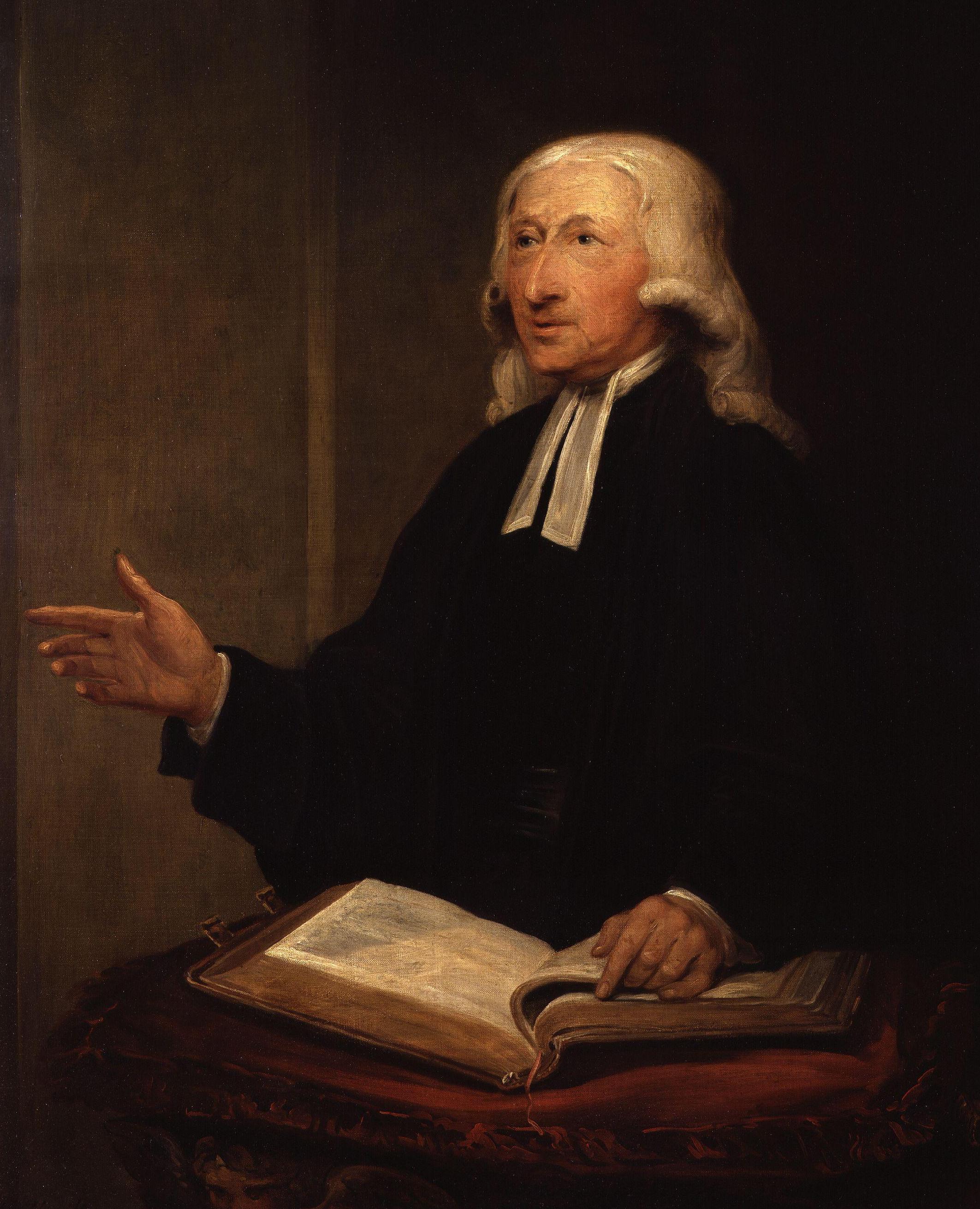
John Wesley, an Anglican priest, was born in 1703, and died eight-eight years later during the time of the French Revolution. As a young man, he was sent to Savannah to be a priest to English settlers in the slave-fueled plantation colony of Georgia. On the way the boat encountered a storm in which the English onboard did not expect to survive, and great fear swept the ship. That is with the exception of a company of Moravian Christians who were on their way to the New World to bring the Gospel to the Native Americans. Wesley's words:
I had long before observed the great seriousness of their behavior. Of their humility they had given a continual proof, by performing those servile offices for the other passengers which none of the English would undertake [...] There was now an opportunity of trying whether they were delivered from the spirit of fear, as well as from that of pride, anger, and revenge. In the midst of the psalm wherewith their service began, the sea broke over, split the mainsail in pieces, covered the ship, and poured in between the decks as if the great deep had already swallowed us up. A terrible screaming began among the English. The Germans calmly sang on. I asked one of them afterwards, 'Were you not afraid?' He answered, 'I thank God, no.' I asked, 'But were not your women and children afraid?' He replied mildly, 'No; our women and children are not afraid to die.'
Wesley, though an ordained minister of the church, didn't have faith like this.
He worked two years in Savannah, but things didn't go as he had hoped, and he returned to England, hurt and burnt out. He sought out the Moravian believers in London, and about an experience he had at one of their meetings in 1738, he famously wrote:
In the evening I went very unwillingly to a society in Aldersgate Street, where one was reading Luther's preface to the Epistle to the Romans. About a quarter before nine, while he was describing the change which God works in the heart through faith in Christ, I felt my heart strangely warmed. I felt I did trust in Christ, Christ alone for salvation, and an assurance was given me that he had taken away my sins, even mine, and saved me from the law of sin and death.
After this, he became an evangelical preacher within the Anglican church. It seems that English society was not in the best of ways. If we are to believe Dickens' description of that era:
It was the best of times, it was the worst of times, it was the age of wisdom, it was the age of foolishness, it was the epoch of belief, it was the epoch of incredulity, it was the season of Light, it was the season of Darkness, it was the spring of hope, it was the winter of despair, we had everything before us, we had nothing before us, we were all going direct to Heaven, we were all going direct the other way...
It seems other authors concur with Dickens that at this period, the Church in England had little moral sway, the rich did what seemed good to them, the poor were busy with a whole other set of vices, and the justice system was anything but. After Wesley's evangelical conversion, he turned his efforts toward preaching Christ, as well as against the deadness and formalism of the Church which had nearly forgotten Christ, and against antinomianism.
Antinomianism. Now there's a mouth full. It means in this case the belief that faith which does not lead to works is still saving faith. I'll let Wesley say some things in his own words:
The moral law, contained in the Ten Commandments and enforced by the prophets, He did not take away. It was not the design of His coming to revoke any part of this. This is a law which can never be broken, which 'stands fast as the faithful witness in heaven.' [...] This was from the beginning of the world, being 'written not on tables of stone,' but on the hearts of all the children of men, when they cam out of the hands of the Creator. And however the letters once wrote by the finger of God are now in a great measure defaced by sin, yet can they not wholly be blotted out, while we have any consciousness of good and evil. Every part of this law must remain in force upon all mankind, and in all ages; as not depending either on time or place, or any other circumstances liable to change, but on the nature of God, and the nature of man, and their unchangeable relation to each other.
There is, therefore, the closest connection that can be conceived, between the law and the gospel. On the one hand, the law continually makes way for, and points us to, the gospel; on the other, the gospel continually leads us to a more exact fulfilling of the law. The law, for instance, requires us to love God, to love our neighbor, to be meek, humble, or holy. We feel that we are not sufficient for these things; yea, that 'with man this is impossible;' but we see a promise of God to give us that love, and to make us humble, meek, and holy: we lay hold of this gospel, of these glad tidings; it is done unto us according to our faith; and 'the righteousness of the law is fulfilled in us,' through faith which is in Christ Jesus.
John Wesley's mother deserves some mention here, and I think of her on occasion. She came from a family of independent religious thinkers, and she wrote extensively on religious topics herself. She gave birth to nineteen children, of whom only eight outlived her - that's approximately one a year, for births; certainly the deaths must have been heartbreaking, although probably not entirely unexpected in her time. She was known for her disciplined home life - making time to talk individually with each child for an hour each week about spiritual things, and making time to pray and hour alone each day - a feat accomplished by putting her apron over her head in the middle of the melee. Her influence on her son John was undoubtedly felt in his own regimented and austure life both before and after his evangelical conversion. Before his conversion he hoped to earn his way to heaven by his careful living. After his conversion, his lifestyle reflected his hope that he would not waste any of God's precious grace, gifts, and light which had been so freely given to him.