Every once in a while I wonder if I'm doing the right thing.... Meaning letting Anne sleep in bed with us and nurse in the night at the rather old age of 18 months. People don't do that. I don't have some doctrinal issue about it; we just do this, because it seems to be working for all three of us at the moment - we get the most sleep this way, and it seems to keep Anne on a happy, even keel. But you know, people don't do that. Children should be able to sleep by themselves. They should have been night-weaned (if not even day-weaned) a long time ago. A long time ago. Toddlers who nurses in bed are going to be spoiled or have life-long sleep problems or disrespect their parents. These are things I occasionally worry about. I'll loosely quote generic American sentiment: "It's tough with kids that you have to worry about their character every time they wake up in the night. Not like cats."
I once again did a little "research" to make sure I wasn't on the total wrong path here. By "research," I mean looking up scientific opinions of those who agree with me. So maybe what I mean is that I did a little internet personal encouragement search.
What was most interesting to me was that in research done with our close relatives, the primates (where culture isn't much of a factor), the life stage at which their infants completely wean is between two and seven human years. Among our closest relatives, the chimps and gorillas, infants wean at the life-stage equivalent of about five and a half to six human years; it's around when they get their first permanent molars and their immune system is pretty much finished. In mammal research of this nature, the predicted natural weaning times for humans (as opposed to cultural) is between 2.5 and seven years.
I was also reminded that, of course, every culture on earth has something to say about when is the right time to wean. It seems that most cultures around the world today promote weaning somewhere between a few months and age four, as well as certain segments preferring never to nurse their infants in the first place. There also seem to be instances of particular children being nursed much longer in some cultures, with some individuals nursing as old as eight or even older. I'm aiming really hard for at least two years, since that's the current World Health Organization recommendation based on medical outcomes.
I couldn't find any information about night-time nursing other than cultural artifacts of the modern USA which say children should start "sleeping through the night" somewhere between three months and maybe a year. It's not clear to me what is meant by "sleeping through the night." One definition I've read is five hours straight. Well, in that case, Anne first slept through the night when she was only a couple of weeks old, and has done it on and off ever since (mostly off, if you really need to know). If we mean sleeping all twelve hours of her typical night without asking for milk at least once, that hasn't happened yet. By now she has relatively frequent nights where she sleeps six hours, nurses mostly in her sleep, and sleeps another six. Especially if she is wearing warm, footed pajamas and gets to nurse several times during the day. Perhaps no comprehensive study has been done on night nursing practices around the world and at what ages children are expected to night-wean. If you know of one, I would be extremely curious to read it.
I also found out that while in our culture, we don't officially believe in babies and children cosleeping with their parents, nearly two-thirds of American babies and toddlers do at some point. In some cultures, it is considered normal for children to cosleep with parents or grandparents or aunties well into the elementary school years. Cosleeping definitions appear to include both the child sleeping in a separate bed near the parent or the child sleeping in the same bed as the parent.
I'm reminding myself that although we have turned out to be rather hippie parents in relation to stated American norms, there are lots of other ideas about how to care for babies and toddlers around the world in cultures which also produce functional adults. Hopefully I'm not ruining my daughter for life. I sort of think she might night-wean before college, and I'm pretty sure she'll want to sleep by herself well before then, too. I have high hopes for her to be a mature, useful, and functional adult by the time she is twenty, too.
These two links contain some of the interesting information which I referenced earlier:
http://www.kathydettwyler.org/commentaries/weaning.html
http://www.naturalchild.org/james_mckenna/cosleeping_world.html
Wednesday, October 29, 2014

Sunday, October 26, 2014
Pumpkin Reformers: John Welsey
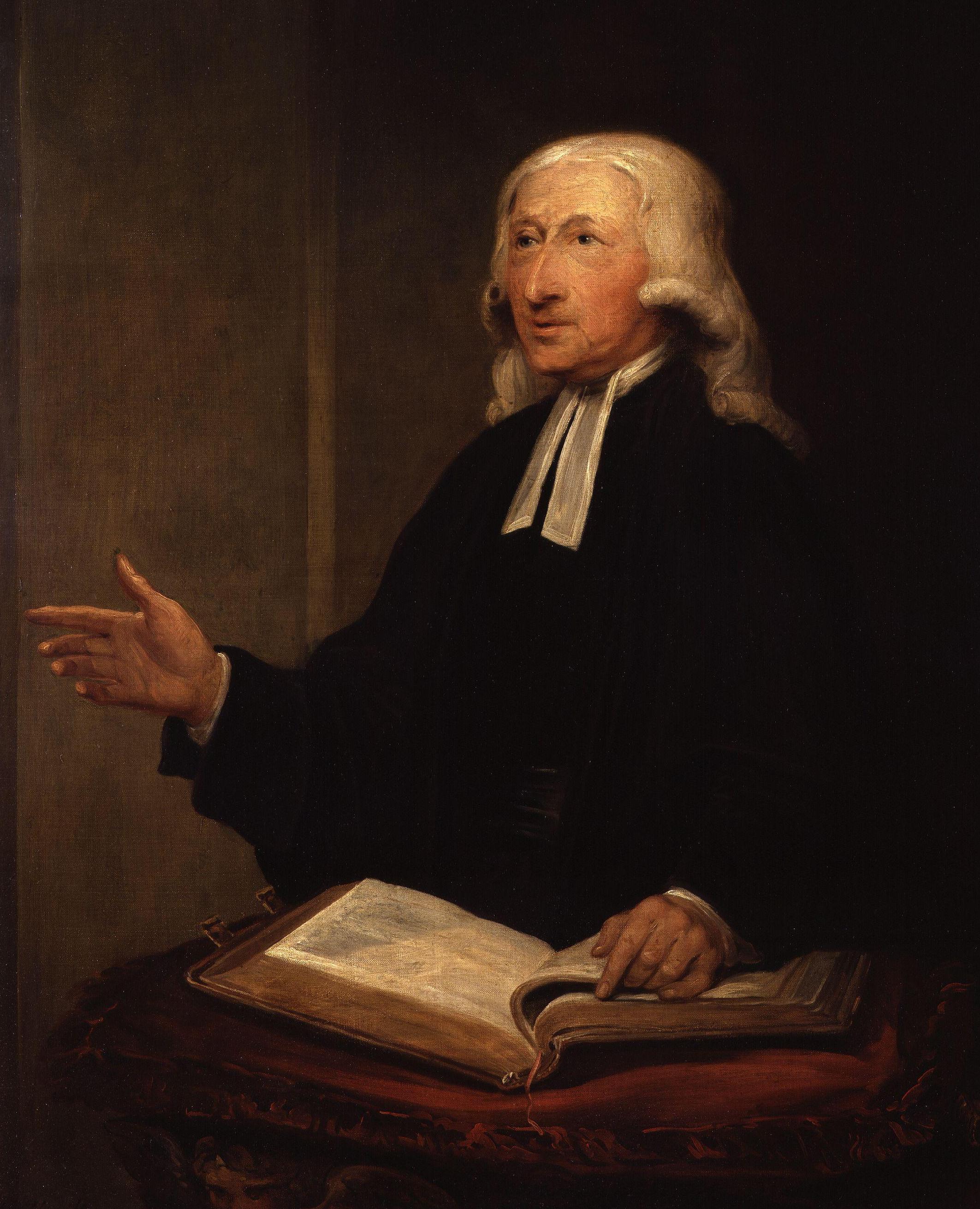
John Wesley, an Anglican priest, was born in 1703, and died eight-eight years later during the time of the French Revolution. As a young man, he was sent to Savannah to be a priest to English settlers in the slave-fueled plantation colony of Georgia. On the way the boat encountered a storm in which the English onboard did not expect to survive, and great fear swept the ship. That is with the exception of a company of Moravian Christians who were on their way to the New World to bring the Gospel to the Native Americans. Wesley's words:
I had long before observed the great seriousness of their behavior. Of their humility they had given a continual proof, by performing those servile offices for the other passengers which none of the English would undertake [...] There was now an opportunity of trying whether they were delivered from the spirit of fear, as well as from that of pride, anger, and revenge. In the midst of the psalm wherewith their service began, the sea broke over, split the mainsail in pieces, covered the ship, and poured in between the decks as if the great deep had already swallowed us up. A terrible screaming began among the English. The Germans calmly sang on. I asked one of them afterwards, 'Were you not afraid?' He answered, 'I thank God, no.' I asked, 'But were not your women and children afraid?' He replied mildly, 'No; our women and children are not afraid to die.'
Wesley, though an ordained minister of the church, didn't have faith like this.
He worked two years in Savannah, but things didn't go as he had hoped, and he returned to England, hurt and burnt out. He sought out the Moravian believers in London, and about an experience he had at one of their meetings in 1738, he famously wrote:
In the evening I went very unwillingly to a society in Aldersgate Street, where one was reading Luther's preface to the Epistle to the Romans. About a quarter before nine, while he was describing the change which God works in the heart through faith in Christ, I felt my heart strangely warmed. I felt I did trust in Christ, Christ alone for salvation, and an assurance was given me that he had taken away my sins, even mine, and saved me from the law of sin and death.
After this, he became an evangelical preacher within the Anglican church. It seems that English society was not in the best of ways. If we are to believe Dickens' description of that era:
It was the best of times, it was the worst of times, it was the age of wisdom, it was the age of foolishness, it was the epoch of belief, it was the epoch of incredulity, it was the season of Light, it was the season of Darkness, it was the spring of hope, it was the winter of despair, we had everything before us, we had nothing before us, we were all going direct to Heaven, we were all going direct the other way...
It seems other authors concur with Dickens that at this period, the Church in England had little moral sway, the rich did what seemed good to them, the poor were busy with a whole other set of vices, and the justice system was anything but. After Wesley's evangelical conversion, he turned his efforts toward preaching Christ, as well as against the deadness and formalism of the Church which had nearly forgotten Christ, and against antinomianism.
Antinomianism. Now there's a mouth full. It means in this case the belief that faith which does not lead to works is still saving faith. I'll let Wesley say some things in his own words:
The moral law, contained in the Ten Commandments and enforced by the prophets, He did not take away. It was not the design of His coming to revoke any part of this. This is a law which can never be broken, which 'stands fast as the faithful witness in heaven.' [...] This was from the beginning of the world, being 'written not on tables of stone,' but on the hearts of all the children of men, when they cam out of the hands of the Creator. And however the letters once wrote by the finger of God are now in a great measure defaced by sin, yet can they not wholly be blotted out, while we have any consciousness of good and evil. Every part of this law must remain in force upon all mankind, and in all ages; as not depending either on time or place, or any other circumstances liable to change, but on the nature of God, and the nature of man, and their unchangeable relation to each other.
There is, therefore, the closest connection that can be conceived, between the law and the gospel. On the one hand, the law continually makes way for, and points us to, the gospel; on the other, the gospel continually leads us to a more exact fulfilling of the law. The law, for instance, requires us to love God, to love our neighbor, to be meek, humble, or holy. We feel that we are not sufficient for these things; yea, that 'with man this is impossible;' but we see a promise of God to give us that love, and to make us humble, meek, and holy: we lay hold of this gospel, of these glad tidings; it is done unto us according to our faith; and 'the righteousness of the law is fulfilled in us,' through faith which is in Christ Jesus.
John Wesley's mother deserves some mention here, and I think of her on occasion. She came from a family of independent religious thinkers, and she wrote extensively on religious topics herself. She gave birth to nineteen children, of whom only eight outlived her - that's approximately one a year, for births; certainly the deaths must have been heartbreaking, although probably not entirely unexpected in her time. She was known for her disciplined home life - making time to talk individually with each child for an hour each week about spiritual things, and making time to pray and hour alone each day - a feat accomplished by putting her apron over her head in the middle of the melee. Her influence on her son John was undoubtedly felt in his own regimented and austure life both before and after his evangelical conversion. Before his conversion he hoped to earn his way to heaven by his careful living. After his conversion, his lifestyle reflected his hope that he would not waste any of God's precious grace, gifts, and light which had been so freely given to him.
Sunday, October 19, 2014
Pumpkin Reformers: Jan Hus
His name was Jan Husinec, but he shortened it some time between his birth in the Bohemian town of that name circa 1369, and his execution in Constance in 1415.

Christianity had first come to Bohemia in the 900's from German-speaking regions in Europe, gradually replacing worship of the pagan Slavic pantheon of gods including Perun, Veles, Jarilo, and Morena, among many others. While the Counsel of Toulouse in 1229 forbade laity from possessing or reading the Bible in the vernacular (with the possible exception of some of the Psalms), Bohemia continued with its long tradition of translating the Vulgate into Czech. Jan Hus likely had access to a Czech Bible before he became a priest in the Catholic Church.
He was a very dedicated (though disadvantaged) student at the University of Prague, which was dominated by the colonial Germans, and at some point after his ordination, he became the rector of the University, as well as the preacher at the Bethlehem Chapel.
Starting in Hus' childhood, Catholic Christianity in Europe experienced a papal schism, and at one time three separate men had been appointed as rival popes. One or more of these popes had major moral failings; one was accused at the Council of Constance of murder, embezzlement, adultery, and "sins not fit to be named." The accusations may have been true, or it may rather demonstrate the depths to which the bishops at the council had sunk in their willingness to accuse an innocent man of such crimes. Prior to that Council, the rival popes had taken military actions against each other, not for theological reasons, but for political reasons. The sale of indulgences for the forgiveness of sins paid for the munitions and soldiers.
Against this backdrop, Hus pointed out the abuses of his beloved Church in an effort to see God change her. Church authorities lashed back at him, and he found himself in danger - ultimately he was excommunicated twice on different charges. Here is a quote from 19th-century historian James Wylie:
Hus also preached that the laity should be given both the bread and the wine at communion; at that time, the priests took the wine, and the laity were only allowed the bread. He cited John 6:53 -
Hus was summoned to the aforementioned Council of Constance, where he was given safe conduct. Despite the promises from temporal rulers, Hus expected to go to his death. In fact, he was found guilty of heresy and burned at the stake. Just before the fires were lit, he was given another chance to recant of his heretical beliefs. He said,
After his death, his teachings, and those of Wycliffe (whose writings he had studied) were spread far and wide; rather than his execution silencing him, it seemed to have help spread his beliefs.

Christianity had first come to Bohemia in the 900's from German-speaking regions in Europe, gradually replacing worship of the pagan Slavic pantheon of gods including Perun, Veles, Jarilo, and Morena, among many others. While the Counsel of Toulouse in 1229 forbade laity from possessing or reading the Bible in the vernacular (with the possible exception of some of the Psalms), Bohemia continued with its long tradition of translating the Vulgate into Czech. Jan Hus likely had access to a Czech Bible before he became a priest in the Catholic Church.
He was a very dedicated (though disadvantaged) student at the University of Prague, which was dominated by the colonial Germans, and at some point after his ordination, he became the rector of the University, as well as the preacher at the Bethlehem Chapel.
Starting in Hus' childhood, Catholic Christianity in Europe experienced a papal schism, and at one time three separate men had been appointed as rival popes. One or more of these popes had major moral failings; one was accused at the Council of Constance of murder, embezzlement, adultery, and "sins not fit to be named." The accusations may have been true, or it may rather demonstrate the depths to which the bishops at the council had sunk in their willingness to accuse an innocent man of such crimes. Prior to that Council, the rival popes had taken military actions against each other, not for theological reasons, but for political reasons. The sale of indulgences for the forgiveness of sins paid for the munitions and soldiers.
Against this backdrop, Hus pointed out the abuses of his beloved Church in an effort to see God change her. Church authorities lashed back at him, and he found himself in danger - ultimately he was excommunicated twice on different charges. Here is a quote from 19th-century historian James Wylie:
"The mind of Huss, at this stage of his career, would seem to have been the scene of a painful conflict. Although the church was seeking to overwhelm him by her thunderbolts, he had not renounced her authority. The Roman Church was still to him the spouse of Christ, and the pope was the representative and vicar of God. What Huss was warring against was the abuse of authority, not the principle itself. This brought on a terrible conflict between the convictions of his understanding and the claims of his conscience. If the authority was just and infallible, as he believed it to be, how came it that he felt compelled to disobey it? To obey, he saw, was to sin; but why should obedience to an infallible church lead to such an issue? This was the problem he could not solve; this was the doubt that tortured him hour by hour. The nearest approximation to a solution which he was able to make was that it had happened again, as once before in the days of the Saviour, that the priests of the church had become wicked persons and were using their lawful authority to unlawful ends. This led him to adopt for his own guidance, and to preach to others for theirs, the maxim that the precepts of Scripture, conveyed through the understanding are to rule the conscience; in other words, that God speaking in the Bible, and not the church speaking through the priesthood, is the one infallible guide."
Hus also preached that the laity should be given both the bread and the wine at communion; at that time, the priests took the wine, and the laity were only allowed the bread. He cited John 6:53 -
Jesus said to them, "Very truly, I tell you, unless you eat the flesh of the Son of Man and drink his blood, you have no life in you."
Hus was summoned to the aforementioned Council of Constance, where he was given safe conduct. Despite the promises from temporal rulers, Hus expected to go to his death. In fact, he was found guilty of heresy and burned at the stake. Just before the fires were lit, he was given another chance to recant of his heretical beliefs. He said,
"What errors shall I renounce? I know myself guilty of none. I call God to witness that all I have written and preached as been with the view of rescuing souls from sin and perdition; and therefore, most joyfully will I confirm with my blood that truth which I have written and preached."
After his death, his teachings, and those of Wycliffe (whose writings he had studied) were spread far and wide; rather than his execution silencing him, it seemed to have help spread his beliefs.
Thursday, October 16, 2014
Could It Be This Simple?
It's time for an overdue book report. I have two books to report on, neither of which were on my Read-It-Before-I-Die Shelf. That shelf has been rather neglected lately. The first book is called Could It Be This Simple?: A Biblical Model for Healing The Mind by Timothy Jennings, M.D. I picked it up off the shelf at my in-law's home, and I almost didn't read it, because I was so put off by the title. As it turns out, I'm not sure the title is a very good fit for the book anyway, and I really appreciated some things I learned.
The biggest revelation to me was a chart that Jennings develops in the chapter called "The Hierarchy of the Mind", which shows how a healthy mind works and how it works in relation to God. I will attempt to reproduce that here:
GOD \
\
\
\ Reason \ Judgment
Spiritual Nature -------- Conscience /
/ Worship
/ Will
Mind
\ Thoughts
(Beliefs, Values, Morals, Imagination)
\
Feelings
(Desire for Relationships, Affections)
A little explanation is in order. Jennings says there are four parts to our minds: our feelings (which includes our desire for relationships and our affections), our thoughts (which includes our beliefs, values, morals, and imagination), our will, and our spiritual nature. Our spiritual nature itself has three parts: reason and conscience, which make up our judgment, and worship. Reason is where we think through things and ask questions of them - is this logical? does this make sense? is this the best decision? is that what the Bible passage really means? Conscience is the voice within, to which God can speak if we allow him. Worship is the part of us which highly values something above other things - it might be a sports team, it might be a cause, it might be our career, it might be a loved one, it might money, it might be feeling safe, it might be a certain dream, it might be an appetite, it might be God. In a well-ordered mind, reason, conscience, and worship work together to inform the will, the thoughts, and the feelings.
However, many of us have minds which are out of order. In extreme forms, think of someone whose feelings are in the driver's seat. Someone whose highest goal is, say, sexual pleasure. This person will allow their feelings on this topic to order everything they do, and you and I both know they will end up with a disaster in life - broken relationships, betrayal, irresponsible behavior, perhaps jail time. Or think of someone whose guiding principle is a belief that one should spread one's religion by force. This person can follow that belief without subjecting it to Truth, and over time turn into a complete brute, devolving to become little more than an Orc. (That's pretty much what I think about the people who have joined ISIS.)
Jennings' premise is that if we put our minds in the proper order and then seek after truth, sifting it through the spiritual nature, we will get closer to God (the Author of all truth), and will become more functional and useful people. He also spends time in the book looking at ways this can go awry, and spends quite a few words on theology (along the lines of Graham Maxwell's Character of God view, if you're familiar with that) that can point us in the direction of connecting with a God who desires out greatest good and healing, and who wants us to examine the evidence for ourselves, freely deciding for or against Him.
The other book was one I had heard of for years (as part of a series), and recently read a little note about it in a magazine article, which sent me off to the library for procurement. The title is The Power of a Praying Parent, and the author is Stormie Omartian. This book has already proved quite useful to me, although it is not a well-researched treatise in the academic or even pastoral sense. It is more of a personal rambling, which builds on the author's experience of praying for her own two children, and teaming up with other parents to pray for their children. I have found it useful, because she provides an abundance of categories in your child's life of things to pray about, and her personal experiences speak to me, since she is a person much further along life's path than I am. She provides sample prayers in her own words for additional help. I especially appreciated some things she had to say about freedom from fear, repentance, and forgiveness, because those are areas I need to grow in.
Back to my own words, I've often thought about Paul's admonition to take every thought captive to Christ, and in the conjunction of reading these two books, I have some new understanding of what that means. Real example...
I'm out running at the same time as Jared, but much slower than he. Imagined conversation in my head:
Jared: Why are you running that way? You could run much faster and keep up with me if you...
RM: Why are you on my case about running slowly? You should just be happy that I'm running at all.
Result: RM is suddenly irritated with Jared, although he did absolutely nothing! He is happily minding his own business and enjoying the fresh air, and now I feel like snarking at him.
RM hears the voice of the Holy Spirit and realizes that this conversation she just imagined is NOT true. It contains lies. She must immediately talk to God about this conversation, ask Him to forgive her snark, and ask Him that He would give her a mind for truth instead.
RM then must think of things that are true: She is outside getting some fresh air and exercise, and it is fun. Jared is outside getting some fresh air and exercise, and he is having fun, too. Jared rarely criticizes RM, and for that she is quite thankful. God can love people who make up stupid and hurtful stories.
RM now has to make a conscious choice not to run her brain down that dead-end track but instead to cooperate with God in thinking whatever is true, whatever is honorable, whatever is pure, whatever is lovely, whatever is gracious, if there is any excellence... It is a battle.
There is a chapter in the Jennings book on Spiritual Warfare, and chances are good that it's not quite what you think. For some this phrase conjures up thoughts of ill-advised Crusades and bigoted legal battles. For others it conjures up weird charistmatic prayer meetings with annointings and speaking in tongues. And for others, it conjures up Name It and Claim It theology. Jennings, however, talks about the battle over our minds for truth - if we are willing to adjust our minds to be accordance with Reality, then we're heading over to the winning side. If we are distancing ourselves from Reality in whatever way, we're walking toward the losing side.
Wednesday, October 15, 2014
Pumpkin Reformers: John Knox
John Knox was one of the later reformers in Great Britain, not just the name of a church camp near Wimberly, Texas. I was, of course, at a certain age, surprised to learn this fact.
A little visual definition:


John Knox, the man: His associates urged him to become a preacher of the Gospel at a time when men were being burned left and right at the stake for heresy. He did not take their suggestions lightly but struggled with the thought for some time before taking up the profession.
The Queen of Scotland charged him with heresy. She said he taught the people to follow a religion prohibited by the state, and was therefore disobedient to God's command that subjects obey their rulers. Here is an excerpt from his eloquent reply, which is a lovely statement about religious freedom which can be applied to all in all times and places (not just the minority Protestants in Scotland at that time):
Prior to this, Knox was enslaved for nineteen months in his mid-twenties. He was residing in a castle with many other Protestants, when the castle was overcome by outside forces, and he became a French galley slave. Other than that, he did travel and live widely - born and died in Scotland, and in the mean time worked in England, France, Switzerland, and Germany.
The Scots Confession was a document detailing the Reformed faith, worked out by a committee of six fellows named John, with John Knox as the overseer and main author. It is quite long, but here is the end bit:
A little visual definition:
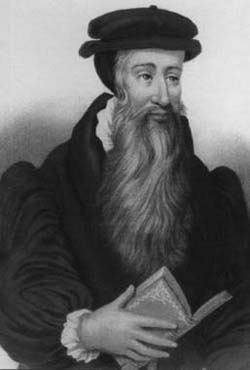
John Knox, the Reformer

John Knox, the central Texas church camp
John Knox, the man: His associates urged him to become a preacher of the Gospel at a time when men were being burned left and right at the stake for heresy. He did not take their suggestions lightly but struggled with the thought for some time before taking up the profession.
The Queen of Scotland charged him with heresy. She said he taught the people to follow a religion prohibited by the state, and was therefore disobedient to God's command that subjects obey their rulers. Here is an excerpt from his eloquent reply, which is a lovely statement about religious freedom which can be applied to all in all times and places (not just the minority Protestants in Scotland at that time):
As right religion took neither original strength nor authority from worldly princes, but from the eternal God alone, so are not subjects bound to frame their religion according to the appetite of their princes. For oft it is that princes are the most ignorant of all others in God's true religion.... If all the seed of Abraham had been of the religion of Pharaoh, whose subjects they long were, I pray you, madam, what religion would there have been in the world? Of if all men in the days of the apostles had been of the religion of the Roman emperors, what religion would there have been upon the face of the earth?... And so madam, ye may perceive that subjects are not bound to the religion of their princes, albeit they are commanded to give them obedience."
Prior to this, Knox was enslaved for nineteen months in his mid-twenties. He was residing in a castle with many other Protestants, when the castle was overcome by outside forces, and he became a French galley slave. Other than that, he did travel and live widely - born and died in Scotland, and in the mean time worked in England, France, Switzerland, and Germany.
The Scots Confession was a document detailing the Reformed faith, worked out by a committee of six fellows named John, with John Knox as the overseer and main author. It is quite long, but here is the end bit:
But such as continue in well doing to the end, boldly confessing the Lord Jesus, shall receive glory, honor, and immortality, we constantly believe, to reign forever in life everlasting with Christ Jesus, to whose glorified body all his chosen shall be made like, when he shall appear again in judgment and shall render up the Kingdom to God his Father, who then shall be and ever shall remain, all in all things, God blessed forever. To whom, with the Son and the Holy Ghost, be all honor and glory, now and ever. Amen.
Arise, O Lord, and let thine enemies be confounded; let them flee from thy presence that hate thy godly Name. Give thy servants strength to speak thy Word with boldness, and let all nations cleave to the true knowledge of thee. Amen
Saturday, October 11, 2014
Pumpkin Reformers: Huldrych Zwingli
It appears that Zwingli, like any other human being, had his virtues as well as his failings. I shall dwell on the former, as I generally try to do for other people. Huldrych was born on January 1st of 1484 in a farm house in a Swiss valley. Here is the house:


His first education was under his Catholic cleric uncle Bartholomew. At the age of ten he was sent to Basel to study. At thirteen he was sent to Bern for a short while. During his stay he had been asked to join the Dominican order, but his uncle and father persuaded him to return home, believing that the monks at that time lived an idle and worthless life. At fourteen he went off to study at the University of Vienna. At eighteen he transferred to the University of Basel, where he received a diploma four years later. That same year he was ordained as a Catholic priest in Constance. In 1519 he nearly died from the Black Plague which swept through, and after his recovery, he preached even more zealously. Eventually, he was excommunicated from the Catholic Church, but he continued working for God through the rest of his life.
Zwingli's first great strides toward reformation in the church came from the belief that the foundation of Christianity should be the Bible, rather than the Church, tradition, or the Church Fathers. He spent a lot of time studying the Bible and comparing passages with each other. He came to believe that many common practices of the Church were not Scriptural. For example, he came out strongly against the selling of indulgences for the forgiveness of sin, stating rather that Christ's sacrifice was the pardon for sin. He also spoke out against the pomp and luxury of the Church, believing these not to be in line with Jesus' humility and simplicity. He also believed that clergy should have the right to marry, and he himself married and had four children. At one of his posts, he was ordered by the Church to serve the sacraments only to the wealthy in an effort to increase tithes and offerings, but he refused to differentiate between classes. Also, following the lead of Erasmus, rather than just offering a weekly homily on the designated Gospel reading, he preached through the entire book of Matthew, line by line; then the book of Acts; then some books of the Old Testament. This was likely the first time many of his hearers would have heard certain portions of these Biblical texts. He also backed away from referring to the sacraments by that name, because he didn't believe that they were magical and mystical, but rather signs or memorials of spiritual realities.
Here are three quotes of his:
"The Scriptures come from God, not form man, and even that God who enlightens will give thee to understand that the speech comes from God. The word of God...cannot fail; it is bright, it teaches itself, it discloses itself, it illumines the soul with all salvation and grace, comforts it in God, humbles it, so that it loses and even forfeits itself, and embraces God."
"It is to Christ that I desire to lead you, -- to Christ, the true source of salvation."
"Wherever there is faith in God, there God is; and wherever God abideth, there a zeal exists urging and impelling men to good works."
Thursday, October 9, 2014
Last Saturday on the East Side of Ranier
It is much drier on the east side of the mountain. But to those from central Texas, it still looks pretty green.


Location of a recent, large washout
Braided river
Some trees on their last roots before a fall
A bit of mysterious, old mining? equipment
...with a brand name
Hiking uphill
Different trees and grasses on the east side
A rivulet runs through a bit of a field
Lots of evidence of rock slides up on that hillside
A lone and beautiful thistle
The top of Rainier from a glacial valley
Churning glacial waters
Evidence of sunset
The moon came up
Looking back at the peak on the way down
A little waterfall
Thursday, October 2, 2014
Anne practices
Anne seems to think that everyone plays the violin or cello, and it is true that 90% of the people who walk through our front door every week are here to make music. As a result, she spends a good amount of time pretending to play on her box violin and her new box cello and doing the practice procedures she sees. To date I've caught her pretending to do the following practice items:
Here she is playing along with Aunt Sara and Daddy and me at Great-Grampa's and Great-Grandma's memorial service, using her box violin:


Sunday morning I finally got it together to make her a box cello. She was so delighted! This picture was not posed. She has watched enough people to know what to do with it.


- Play a scale where she says the note name before each pitch
- Sing pitch flash cards
- Scrub rhythm flash cards on her left arm
- Sing Twinkle Twinkle Little Star
- Swing her violin arm up to her nose to practice the proper shoulder-supported rotation
- Taking a bow
- Making rest position with her violin
- Bowing on her shoulder
- Stepping the beats while playing
- Stepping the beats while clapping the rhythms
- Doing this with music on the stand and with the metronome on
- Singing the metronome's A
- Bowing on her violin
- Bowing on her cello
- Doing pizzicato on both
- Cello hug exercise
- Finger/arm flicks
- Finger taps
- Pretend to tune using both the pegs and the fine tuners
- Pretend to tighten and loosen the bow
- Knuckle knock exercise
- Putting her fingers on the strings
- Knee bends
- Up Like a Rocket
- Wiggle thumb
- Put her instrument into the case and close it
With a number of these she has some of the details wrong - like bowing on the right shoulder rather than the left, or swinging her first finger to her nose rather than her pinky. She often does stuff with the wrong hands, but ever since I first made her the box violin (before she was walking), she has always put it right-side up on the left side and used the bow with her right hand.
Here she is playing along with Aunt Sara and Daddy and me at Great-Grampa's and Great-Grandma's memorial service, using her box violin:
A student of mine left her rhythm and singing cards at a lesson. Anne sat in my case and pretended to scrub the rhythms and sing the pitches.
Sunday morning I finally got it together to make her a box cello. She was so delighted! This picture was not posed. She has watched enough people to know what to do with it.
Sometimes she is allowed to play with my viola under close supervision. It is a sturdy school-rental grade, so I'm not too worried about her using it surrounded by pillows. She is quite gentle.
Here's a picture from a year ago when she wasn't sitting up by herself yet, playing with her decoy practice bow.
Here is an early picture of her in the vicinity of her box violin.
A musical shirt that a family from group class made her:
These next two pictures are not posed either. She set this up herself, and Jared called me in to watch. Fortunately I got the camera out in time.
Wednesday, October 1, 2014
October: Pumpkin Reformers
I was musing out loud in the car with Jared yesterday about how some people have a family spiritual discipline in December usingAdvent calenders, and some people have a family spiritual discipline in November using trees or chains of Thanksgiving. I was thinking, maybe such people needed something for October. We drove by a u-pick pumpkin farm as I was saying this....
Of course, Christmas and Thanksgiving have Christian meanings for many people, but October is somewhat devoid of such holidays. Well, there's Halloween... Overlaid with All-Souls/All-Saints... Overlaid with Reformation Day. I suddenly hit upon the idea. Take a month to study a different Protestant Reformer each day, and write their names on pumpkins. Corny, I know. And also, my resources for such a project are rather diffuse. So Jared suggested I really do it but just pick four reformers, one for each week. That would be manageable. If you steal my corny idea and do a Pumpkin Reformers Month, tell me how you did it! So then Jared asked me who I would do this year.
I came up with:
1) Huldrych Zwingli, because he has the coolest name ever. Ever. If I had a lot of sons, one of them would probably get named Zwingli.
2) John Knox, because of my Presbyterian heritage. Our nearest church camp growing up was called John Knox Ranch. I associated the name with the Texas Hill Country and was a little bemused to walk around the outside of John Knox's actual church in Scotland.
3) Jan Hus, because he also has a fantastic name.
4) John Wesley, because I have a soft spot for Methodism.
You probably already know this about me, but I'm not a person who is against a little Halloween fun. Here is how Jared and Anne and I showed up for group class on October 31st last year, although I think we were a little more vertical than these pictures suggest:
RM, the Christmas elf
Jared, the professional musician
Anne, the wearer of the First Halloween pajamas
Subscribe to:
Posts (Atom)